Funciones Privadas
Las funciones privadas son cuerpos de código reutilizables que aceptan cero o más argumentos y producen una única salida.
Descripción general
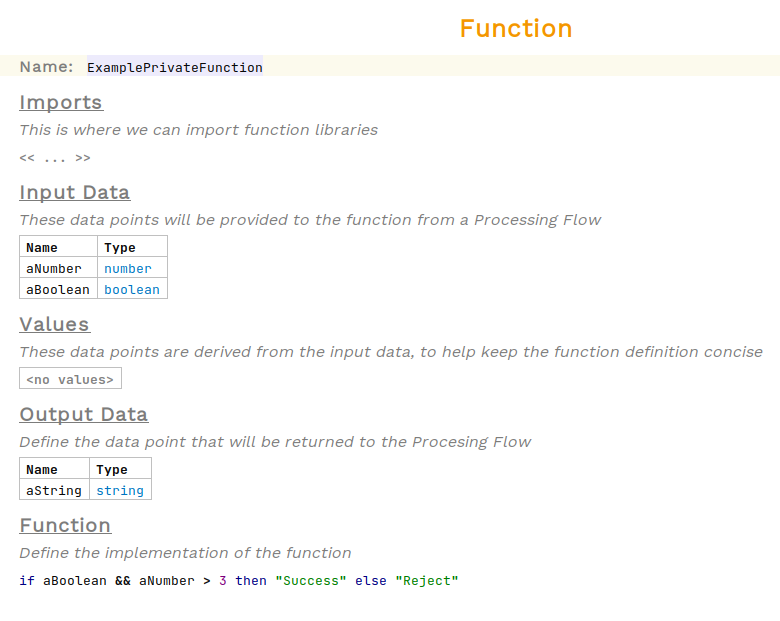
Una función se comporta de manera similar a los métodos en muchos lenguajes de programación; toma entradas como argumentos y devuelve un resultado. Los argumentos de una función se definen como datos de entrada, tienen un nombre y un tipo de registro (o primitivo) de Kernel F.
Las funciones pueden opcionalmente definir valores internos, que son similares a las variables locales. Son útiles para extraer valores de una entrada compleja o derivar valores a través de algunas llamadas a funciones con el fin de mantener la lógica de la función clara y concisa.
Al definir una función, el tipo de retorno debe especificarse en su campo de datos de salida. El valor devuelto en el cuerpo de la función debe coincidir con el tipo de retorno.
A continuación se muestra una función de ejemplo simple:
Diferencias entre Funciones y Funciones Privadas
Mientras que las Funciones Privadas tienen una forma similar a la de los nodos de Función, son diferentes.
Aquí tiene una lista de las principales diferencias entre ellos.
Diferencia |
Función |
Función Privada |
Data Type s |
Tanto la entrada como la salida son Java tipos |
Tanto la entrada como la salida son Registros/Primitivas del Núcleo F. |
Ubicaciones de Uso |
Llamar a una función es una acción dentro de un flujo. |
Llamado desde los cuerpos de Decisions, Validaciones, Funciones u otras Funciones Privadas |
Uso previsto |
Para mapping a los datos empresariales dentro del DSL |
Para escribir lógica dentro del DSL |