Building a CSM Service implementation
This guide will explain how to bootstrap your own CSM service implementation using the pre-built CSM service starter library.
Purpose
All IPF CSM services implement the various IPF payment APIs (as documented in APIs), including:
-
Clear and Settle
-
Receive Payment
-
Send Recall to CSM
And so on.
The CSM service starter library bundles the following components together for ease of development for those wanting to create their own CSM service implementation:
-
API definitions
-
Kafka and JMS bindings for communication between an IPF application and the CSM service
-
Default interfaces for receiving messages from the IPF application, which are then forwarded to the scheme
-
Default implementations for forwarding messages from the scheme to the IPF application
Steps
Here’s how to get started with creating your own CSM service implementation.
Step 1: Add required dependencies
The dependencies you need to add depend on which transport bindings you want to use in your implementation.
These dependencies are all available as part of the ipf-bom. If you are using this, you don’t need to specify any versions as you will receive the CSM Service Starter library version that has been validated for the ipf-bom in use.
|
| Transport type | Dependency |
|---|---|
Kafka |
<dependency>
    <groupId>com.iconsolutions.ipf.payments.csm</groupId>
    <artifactId>csm-service-starter-kafka</artifactId>
</dependency>
|
JMS |
<dependency>
    <groupId>com.iconsolutions.ipf.payments.csm</groupId>
    <artifactId>csm-service-starter-jms</artifactId>
</dependency>
|
Step 2: Implement API interfaces for receiving messages from IPF to forward to scheme
csm-service-starter-* provides two API interfaces for receiving messages from an IPF application which will then be forwarded to the scheme:
-
com.iconsolutions.instantpayments.csm.ct.CsmApiReceiver: for credit transfer-type messages -
com.iconsolutions.instantpayments.csm.rrr.CsmRApiReceiver: for recall/return/result of investigation-type messages -
com.iconsolutions.instantpayments.csm.dd.CsmDDApiReceiver: for direct debit-type messages
Implementations of these interfaces must be Spring bean classes, and there are no default method implementations.
Taking the CsmApiReceiver interface as an example, the simplest implementation will look something like this:
import com.iconsolutions.instantpayments.csm.ct.CsmApiReceiver;
import com.iconsolutions.ipf.payments.api.csm.clearandsettle.api.ClearAndSettleRequest;
import org.springframework.stereotype.Component;
import java.util.concurrent.CompletableFuture;
import java.util.concurrent.CompletionStage;
// Additional required imports here...

@Component (1)
public class MyCsmApiReceiver implements CsmApiReceiver { (2)

    @Override
    public CompletionStage<Void> clearAndSettle(ClearAndSettleRequest clearAndSettleRequest) {
        return CompletableFuture.completedStage(null);
    }

    // Other overridden methods here...

}| 1 | Defining the implementation class as a Spring bean |
| 2 | Implementing the (credit-transfer) receiver API interface |
Step 3: Handle an incoming request from IPF and forward to the scheme
The implementation of each method in this class depends on how you want to process the incoming message (within the limits of the supported workflow for this message type). Using the clearAndSettle method as an example (which defines the IPF application to CSM Service interface for the Debtor Credit Transfer Flow), processing of the message, in its simplest form, would typically involve:
-
forwarding the incoming request from IPF to a destination from which a scheme can consume it
-
sending an acknowledgment (technical response) to IPF after the request has been delivered to its destination
csm-service-starter-* provides the send connector for sending the acknowledgement to IPF (TechnicalResponseSender) and the required acknowledgement response type (TechnicalResponse), but we will need to create our own send connector to send the incoming request to the CSM.
The default locations from which messages are consumed by the provided ReceiveConnectors and produced to by the provided SendConnectors can be found on the transport reference page. You can use the configuration paths on this page (listed under the Config Key columns in the table) to override these default location values as necessary.
|
This SendConnector will need to be provided with:
-
The appropriate transport for the CSM (Kafka or JMS)
-
A function to transform the incoming request (
ClearAndSettleRequest) to the target CSM scheme type (scheme specific pacs.008) and enrich specific static values on the transformed message, e.g. instructing/instructed agent, clearing system, local instrument, etc. -
A function to convert the transformed scheme-specific pacs.008 message to the target output format, usually XML or bank-proprietary XML
Please see the Kafka Quickstart or JMS Quickstart pages for guidance on creating your own SendConnector transport.
The simplest way to transform the incoming request to the target CSM scheme type and enrich the transformed message is to use the IPF mapping framework and leverage the provided com.iconsolutions.instantpayments.csm.MapperRegistry. First, create a Spring bean class that implements the com.iconsolutions.instantpayments.csm.MessageMapper<FromType, ToType> interface and contains your mapping function:
import com.iconsolutions.instantpayments.csm.MessageMapper;
import com.iconsolutions.ipf.payments.api.csm.clearandsettle.api.ClearAndSettleRequest;
import com.myorg.myproject.mycsm.model.Header;
import com.myorg.myproject.mycsm.model.ct.MyCsmOutboundCTRequest;
import com.iconsolutions.ipf.transformation.TransformationService;
import lombok.RequiredArgsConstructor;
import lombok.extern.slf4j.Slf4j;
import org.springframework.stereotype.Component;
import mycsm.scti.iso.std.iso._20022.tech.xsd.pacs_008_001_08.FIToFICustomerCreditTransferV08;

@Slf4j
@RequiredArgsConstructor
@Component
public class IpfToMyCsmPacs008Mapper implements MessageMapper<ClearAndSettleRequest, MyCsmOutboundCTRequest> { (1)

    private final TransformationService transformationService; (2)

    @Override
    public Class<ClearAndSettleRequest> supportedType() { (3)
        return ClearAndSettleRequest.class;
    }

    @Override
    public MyCsmOutboundCTRequest map(ClearAndSettleRequest request) {
        log.debug("Mapping ClearAndSettleRequest with id: {}", request.getRequestId());
        var fi2fi = transformationService.mapThenEnrichWithDefault(request.getPayload().getContent(), FIToFICustomerCreditTransferV08.class); (4)
        // Set some additional fields (e.g. accptncDtTm) on the transformed message here
        return new MyCsmOutboundCTRequest(new Header(request.getRequestId()), fi2fi); (5)
    }
}| 1 | Implementing the MessageMapper interface, with FromType=ClearAndSettleRequest and ToType=MyCsmOutboundCTRequest |
| 2 | Wiring in the IPF mapping framework TransformationService |
| 3 | Instructing the MappingRegistry to use this mapper when mapping a ClearAndSettleRequest type |
| 4 | Transforming the request payload from an IPF ISO20022 canonical pacs.008 to its scheme-specific equivalent |
| 5 | Creating a new MyCsmOutboundCTRequest, which is a custom object that allows you to send a Header with your message in the SendConnector: |
import mycsm.scti.iso.std.iso._20022.tech.xsd.pacs_008_001_08.FIToFICustomerCreditTransferV08;
import com.myorg.myproject.mycsm.model.Header;
import lombok.AllArgsConstructor;
import lombok.Data;

@Data
@AllArgsConstructor
public class MyCsmOutboundCTRequest {
    private Header header;
    private FIToFICustomerCreditTransferV08 payload;
}
import lombok.AllArgsConstructor;
import lombok.Data;
@Data
@AllArgsConstructor
public class Header {
private String aUsefulHeaderId;
}Now wire in this mapper, via the MapperRegistry, into a Spring bean class that will act as a base for all of your mapping logic:
import com.iconsolutions.instantpayments.csm.MapperRegistry;
import com.iconsolutions.ipf.payments.api.csm.clearandsettle.api.ClearAndSettleRequest;
import com.myorg.myproject.mycsm.model.ct.MyCsmOutboundCTRequest;
import org.springframework.stereotype.Component;

@Component
public class MyCsmMapper {

    private final MapperRegistry mapperRegistry; (1)

    public MyCsmMapper(final MapperRegistry mapperRegistry) {
        this.mapperRegistry = mapperRegistry;
    }

    public MyCsmOutboundCTRequest map(ClearAndSettleRequest clearAndSettleRequest) {
        return mapperRegistry.map(clearAndSettleRequest);
    }
}| 1 | Wiring in the MapperRegistry which now contains the IpfToMyCsmPacs008Mapper |
The target output message format for a CSM will typically be XML. Therefore, we need to convert the scheme-specific pacs.008 java object into XML before sending.
Firstly, we will need to create a JAXBContext containing the scheme-specific pacs.008 Document definition:
private JAXBContext myCsmJAXBContext() throws JAXBException {
    return JAXBContext.newInstance(mycsm.scti.iso.std.iso._20022.tech.xsd.pacs_008_001_08.Document.class);
}
Then we will need to create a marshaller using the IPF provided com.iconsolutions.mapper.JaxbObjectToStringMapper<> and the JAXBContext created above:
private JaxbObjectToStringMapper<Object> marshaller() {
    return new JaxbObjectToStringMapper<>(myCsmJAXBContext(), false); (1)
}| 1 | Setting "jaxb.formatted.output" to false as we don’t need JAXB to format the output here |
If desired, you have the option to include schema validation in the marshaller. To do this, we first need to create a Resource from the scheme pacs.008 xsd file:
@Value("classpath:xsd/mycsm_pacs_008.xsd")
private Resource myCsmPacs008Xsd;
Then we create our Schema definition in the following way:
private Schema myCsmSchema() throws IOException, SAXException {
    StreamSource[] schemaStreamSources = {
            new StreamSource(myCsmPacs008Xsd.getInputStream())
    };
    return SchemaFactory.newInstance(W3C_XML_SCHEMA_NS_URI).newSchema(schemaStreamSources);
}
And we can then include this within our marshaller definition:
private JaxbObjectToStringMapper<Object> marshaller() {
    return new JaxbObjectToStringMapper<>(myCsmJAXBContext(), myCsmSchema(), false);
}
We then use our marshaller to convert the MyCsmOutboundCTRequest to our target (transport) message format:
public TransportMessage convertToTransport(MyCsmOutboundCTRequest request) {
    var myCsmPacs008ObjectFactory = new mycsm.scti.iso.std.iso._20022.tech.xsd.pacs_008_001_08.ObjectFactory();
    var document = myCsmPacs008ObjectFactory.createDocument();
    document.setFIToFICstmrCdtTrf(request.getPayload());
    var convertedMessage = marshaller.map(document);
    log.debug("Converted MyCsmOutboundCTRequest to transport message type: {}", convertedMessage);
    return new TransportMessage(convertedMessage);
}
Including all of this above, MyCsmMapper now looks like this:
import lombok.extern.slf4j.Slf4j;
import org.springframework.stereotype.Component;
import com.iconsolutions.instantpayments.csm.MapperRegistry;
import com.iconsolutions.mapper.JaxbObjectToStringMapper;
import org.springframework.core.io.Resource;
import com.iconsolutions.ipf.payments.api.csm.clearandsettle.api.ClearAndSettleRequest;
import com.myorg.myproject.mycsm.model.ct.MyCsmOutboundCTRequest;
import com.iconsolutions.ipf.core.connector.message.TransportMessage;
import jakarta.xml.bind.JAXBContext;
import javax.xml.transform.stream.StreamSource;
import javax.xml.validation.SchemaFactory;
import jakarta.xml.bind.JAXBException;
import org.xml.sax.SAXException;
import java.io.IOException;

@Slf4j
@Component
public class MyCsmMapper {

    private final MapperRegistry mapperRegistry;
    private final JaxbObjectToStringMapper<Object> marshaller;

    public MyCsmMapper(@Value("classpath:xsd/mycsm_pacs_008.xsd") Resource myCsmPacs008Xsd,
                       final MapperRegistry mapperRegistry) {
        this.mapperRegistry = mapperRegistry;
        this.marshaller = marshaller();
    }

    public MyCsmOutboundCTRequest map(ClearAndSettleRequest clearAndSettleRequest) {
        return mapperRegistry.map(clearAndSettleRequest);
    }

    public TransportMessage convertToTransport(MyCsmOutboundCTRequest request) {
        var myCsmpacs008ObjectFactory = new mycsm.scti.iso.std.iso._20022.tech.xsd.pacs_008_001_08.ObjectFactory();
        var document = myCsmpacs008ObjectFactory.createDocument();
        document.setFIToFICstmrCdtTrf(request.getPayload());
        var convertedMessage = marshaller.map(document);
        log.debug("Converted MyCsmOutboundCTRequest to transport message type: {}", convertedMessage);
        return new TransportMessage(convertedMessage);
    }

    private JaxbObjectToStringMapper<Object> marshaller() {
        return new JaxbObjectToStringMapper<>(myCsmJAXBContext(), myCsmSchema(), false);
    }

    private JAXBContext myCsmJAXBContext() throws JAXBException {
        return JAXBContext.newInstance(mycsm.scti.iso.std.iso._20022.tech.xsd.pacs_008_001_08.Document.class);
    }

    private Schema myCsmSchema() throws IOException, SAXException {
        StreamSource[] schemaStreamSources = {
                new StreamSource(myCsmPacs008Xsd.getInputStream())
        };
        return SchemaFactory.newInstance(W3C_XML_SCHEMA_NS_URI).newSchema(schemaStreamSources);
    }
}
Now we have all the required components for the SendConnector, we can go ahead and create it:
import akka.actor.ClassicActorSystemProvider;
import com.iconsolutions.ipf.core.connector.SendConnector;
import com.iconsolutions.ipf.core.connector.transport.ConnectorTransport;
import com.iconsolutions.ipf.core.messagelogger.MessageLogger;
import com.iconsolutions.ipf.core.shared.correlation.CorrelationId;
import com.iconsolutions.ipf.core.shared.correlation.CorrelationService;
import com.iconsolutions.ipf.payments.api.csm.clearandsettle.api.ClearAndSettleRequest;
import com.myorg.myproject.mycsm.mapper.ct.MyCsmMapper;
import com.myorg.myproject.mycsm.model.ct.MyCsmOutboundCTRequest;
import org.springframework.boot.autoconfigure.AutoConfiguration;
import org.springframework.context.annotation.Bean;

@AutoConfiguration
public class MyCsmConfig {

    private final ClassicActorSystemProvider actorSystem;
    private final CorrelationService correlationService;
    private final MessageLogger messageLogger;

    public MyCsmConfig(ClassicActorSystemProvider actorSystem,
                       CorrelationService correlationService,
                       MessageLogger messageLogger) {
        this.actorSystem = actorSystem;
        this.correlationService = correlationService;
        this.messageLogger = messageLogger;
    }

    @Bean
    SendConnector<ClearAndSettleRequest, MyCsmOutboundCTRequest> clearAndSettleRequestSendConnector(MyCsmMapper mapper,
                                                                                                    ConnectorTransport<MyCsmOutboundCTRequest> transport) {
        String connectorName = "myCsmClearAndSettleRequestSender";
        String configRoot = "my-csm.send-cas-connector";
        return SendConnector.<ClearAndSettleRequest, MyCsmOutboundCTRequest>builder(connectorName, configRoot, actorSystem)
                .withMessageLogger(messageLogger)
                .withCorrelationService(correlationService)
                .withConnectorTransport(transport)
                .withDomainToTargetTypeConverter(clearAndSettleRequest -> mapper.map(clearAndSettleRequest)) (1)
                .withSendTransportMessageConverter(outboundRequest -> mapper.convertToTransport(outboundRequest)) (2)
                .withCorrelationIdExtractor(outboundRequest -> CorrelationId.of(outboundRequest.getPayload().getGrpHdr().getMsgId()))
                .build();
    }
}| 1 | Using our MyCsmMapper's map() method to transform the incoming ClearAndSettleRequest to the output MyCsmOutboundCTRequest type |
| 2 | Using our MyCsmMapper's convertToTransport() method to convert the MyCsmOutboundCTRequest to the target output XML format |
| Please visit the Sending Connector page if you are unfamiliar with any of the other SendConnector options provided above. |
With our SendConnector now created, we can provide an implementation for the clearAndSettle method in our MyCsmApiReceiver class:
import com.iconsolutions.instantpayments.csm.ct.CsmApiReceiver;
import com.iconsolutions.ipf.payments.api.csm.clearandsettle.api.ClearAndSettleRequest;
import com.myorg.myproject.mycsm.model.ct.MyCsmOutboundCTRequest;
import com.iconsolutions.instantpayments.csm.TechnicalResponseSender;
import lombok.RequiredArgsConstructor;
import org.springframework.stereotype.Component;
import java.util.concurrent.CompletionStage;
import java.time.Instant;
import java.util.UUID;
// Additional required imports here...

@RequiredArgsConstructor
@Component
public class MyCsmApiReceiver implements CsmApiReceiver { (2)

    private final SendConnector<ClearAndSettleRequest, MyCsmOutboundCTRequest> clearAndSettleRequestSendConnector;
    private final TechnicalResponseSender technicalResponseSender;

    @Override
    public CompletionStage<Void> clearAndSettle(final ClearAndSettleRequest request) {
        log.debug("Handling clear and settle request for id: {}", request.getRequestId());
        return clearAndSettleRequestSendConnector.send(request.getProcessingContext(), request) (1)
                .thenCompose(deliveryOutcome -> {
                    final var sendOutcomeSuccess = deliveryOutcome.getDeliveryReport().getOutcome() == DeliveryReport.Outcome.SUCCESS;
                    return technicalResponseSender.send(TechnicalResponse.builder() (2)
                            .responseId(UUID.randomUUID().toString())
                            .requestId(request.getRequestId())
                            .processingContext(request.getProcessingContext())
                            .version(request.getVersion())
                            .createdAt(Instant.now())
                            .ipfId(request.getIpfId())
                            .responseCode(StringUtils.EMPTY)
                            .status(sendOutcomeSuccess ? PaymentResponse.Status.SUCCESS : PaymentResponse.Status.FAILURE)
                            .reason(sendOutcomeSuccess ? "" : deliveryOutcome.getDeliveryReport().getDeliveryException().toString())
                            .build());
                });
    }

    // Other overridden methods here...

}| 1 | Sending the clear and settle request message received by the CSM service to a configured destination using our ClearAndSettleSendConnector |
| 2 | Sending a technical response back to the IPF application after the clear and settle request message has been delivered using the SendConnector and response type provided in the csm-service-starter-* library |
Step 4: Handle an incoming response from a CSM
In the previous step, we implemented a method to handle an incoming clear and settle request from IPF. Now we need to provide a way of handling the response we get for this request from the CSM. For this scenario, csm-service-starter-* provides a SendConnector for forwarding the response back to IPF, but we will need to create our own ReceiveConnector to consume the response from the CSM.
This ReceiveConnector will need to be provided with:
-
The appropriate transport for the CSM (Kafka or JMS)
-
A function that converts the XML formatted payment status report from the scheme to the scheme-specific pacs.002 java object, and then transforms this into a
ClearAndSettleResponse -
A function to forward the
ClearAndSettleResponseto IPF
Please see the Kafka Quickstart or JMS Quickstart pages for guidance on creating your own ReceiveConnector transport.
Just as we did earlier in Step 3, the initial stage in converting the payment status report XML from the scheme to the scheme-specific pacs.002 java object is to create a JAXBContext containing the scheme-specific pacs.002 Document definition. We can add this definition to our previously created JAXBContext:
private JAXBContext myCsmJAXBContext() throws JAXBException {
    return JAXBContext.newInstance(
            mycsm.scti.iso.std.iso._20022.tech.xsd.pacs_008_001_08.Document.class,
            mycsm.scti.iso.std.iso._20022.tech.xsd.pacs_002_001_10.Document.class
        );
}
Then we will need to create an unmarshaller using the IPF provided com.iconsolutions.mapper.StringToJaxbObjectMapper<> and the JAXBContext created above:
private StringToJaxbObjectMapper<Object> unmarshaller() {
    return new StringToJaxbObjectMapper<>(myCsmJAXBContext());
}
Again, you have the option to include schema validation in the unmarshaller. To do this, we need to create another Resource from the scheme pacs.002 xsd file:
@Value("classpath:xsd/mycsm_pacs_002.xsd")
private Resource myCsmPacs002Xsd;
Then we add this to our previously created Schema definition:
private Schema myCsmSchema() throws IOException, SAXException {
    StreamSource[] schemaStreamSources = {
            new StreamSource(myCsmPacs008Xsd.getInputStream()),
            new StreamSource(myCsmPacs002Xsd.getInputStream())
    };
    return SchemaFactory.newInstance(W3C_XML_SCHEMA_NS_URI).newSchema(schemaStreamSources);
}
And we can then include this within our unmarshaller definition:
private StringToJaxbObjectMapper<Object> unmarshaller() {
    return new StringToJaxbObjectMapper<>(myCsmJAXBContext(), myCsmSchema());
}
We then use our unmarshaller to convert the payment status report XML from the scheme to the scheme-specific pacs.002 java object:
var messageXml = transportMessage.getPayload().toString();
var myCsmPacs002 = unmarshaller.map(messageXml);
To transform the unmarshalled scheme-specific pacs.002 to a ClearAndSettleResponse, we can again leverage the provided com.iconsolutions.instantpayments.csm.MapperRegistry and create a Spring bean class that implements the com.iconsolutions.instantpayments.csm.MessageMapper<FromType, ToType> interface and contains the required mapping function:
import com.iconsolutions.instantpayments.csm.MessageMapper;
import com.myorg.myproject.mycsm.model.ct.MyCsmOutboundCTResponse;
import com.myorg.myproject.mycsm.model.Header;
import com.iconsolutions.ipf.transformation.TransformationService;
import lombok.RequiredArgsConstructor;
import lombok.extern.slf4j.Slf4j;
import org.springframework.stereotype.Component;
import com.iconsolutions.iso20022.message.definitions.payments_clearing_and_settlement.pacs002.FIToFIPaymentStatusReportV10;
import mycsm.scti.iso.std.iso._20022.tech.xsd.pacs_002_001_10.Document;
import com.iconsolutions.ipf.payments.api.csm.clearandsettle.api.ClearAndSettleResponse;

@Slf4j
@RequiredArgsConstructor
@Component
public class MyCsmToIpfPacs002Mapper implements MessageMapper<Document, MyCsmOutboundCTResponse> {

    private static final Version VERSION = new Version(1, 0, 0);

    private final TransformationService transformationService;

    @Override
    public Class<Document> supportedType() {
        return Document.class;
    }

    @Override
    public MyCsmOutboundCTResponse map(Document schemePaymentStatusReportDocument) {
        var schemePaymentStatusReport = schemePaymentStatusReportDocument.getFIToFIPmtStsRpt();
        log.debug("Mapping scheme PaymentStatusReport: {}", schemePaymentStatusReport);
        var isoPaymentStatusReport = transformationService.map(schemePaymentStatusReport, FIToFIPaymentStatusReportV10.class);
            return new MyCsmOutboundCTResponse( (1)
                    new Header(schemePaymentStatusReport.getOrgnlGrpInfAndSts().getOrgnlMsgId()),
                    ClearAndSettleResponse.builder()
                            .responseId(schemePaymentStatusReport.getTxInfAndSts().getOrgnlTxId())
                            .requestId(isoPaymentStatusReport.getGrpHdr().getMsgId())
                            .version(VERSION)
                            .createdAt(Instant.now())
                            .payload(new Payload<>(isoPaymentStatusReport, VERSION))
                            .status(status)
                            .build());
    }
}| 1 | Creating a new MyCsmOutboundCTResponse, which is a custom object that allows you to send a Header with the ClearAndSettleResponse in the ClearAndSettleSendConnector: |
import com.iconsolutions.ipf.payments.api.csm.clearandsettle.api.ClearAndSettleResponse;
import com.myorg.myproject.mycsm.model.Header;
import lombok.AllArgsConstructor;
import lombok.Data;

@Data
@AllArgsConstructor
public class MyCsmOutboundCTResponse {
    private Header header;
    private ClearAndSettleResponse payload;
}
Bringing this all together, our MyCsmMapper now looks like this:
import lombok.extern.slf4j.Slf4j;
import org.springframework.stereotype.Component;
import com.iconsolutions.instantpayments.csm.MapperRegistry;
import com.iconsolutions.mapper.JaxbObjectToStringMapper;
import org.springframework.core.io.Resource;
import com.iconsolutions.ipf.payments.api.csm.clearandsettle.api.ClearAndSettleRequest;
import com.myorg.myproject.mycsm.model.ct.MyCsmOutboundCTRequest;
import com.myorg.myproject.mycsm.model.ct.MyCsmOutboundCTResponse;
import com.iconsolutions.ipf.core.connector.message.TransportMessage;
import jakarta.xml.bind.JAXBContext;
import javax.xml.transform.stream.StreamSource;
import javax.xml.validation.SchemaFactory;
import com.iconsolutions.mapper.JaxbObjectToStringMapper;
import com.iconsolutions.mapper.StringToJaxbObjectMapper;
import jakarta.xml.bind.JAXBException;
import org.xml.sax.SAXException;
import java.io.IOException;

@Slf4j
@Component
public class MyCsmMapper {

    private final MapperRegistry mapperRegistry;
    private final JaxbObjectToStringMapper<Object> marshaller;
    private final StringToJaxbObjectMapper<Object> unmarshaller;


    public MyCsmMapper(@Value("classpath:xsd/mycsm_pacs_008.xsd") Resource myCsmPacs008Xsd,
                       @Value("classpath:xsd/mycsm_pacs_002.xsd") Resource myCsmPacs002Xsd,
                       final MapperRegistry mapperRegistry) {
        this.mapperRegistry = mapperRegistry;
        this.marshaller = marshaller();
        this.unmarshaller = unmarshaller();
    }

    public MyCsmOutboundCTRequest map(ClearAndSettleRequest clearAndSettleRequest) {
        return mapperRegistry.map(clearAndSettleRequest);
    }

    public TransportMessage convertToTransport(MyCsmOutboundCTRequest request) {
        var myCsmpacs008ObjectFactory = new mycsm.scti.iso.std.iso._20022.tech.xsd.pacs_008_001_08.ObjectFactory();
        var document = myCsmpacs008ObjectFactory.createDocument();
        document.setFIToFICstmrCdtTrf(request.getPayload());
        var convertedMessage = marshaller.map(document);
        log.debug("Converted MyCsmOutboundCTRequest to transport message type: {}", convertedMessage);
        return new TransportMessage(convertedMessage);
    }

    public MyCsmOutboundCTResponse convertToResponse(TransportMessage transportMessage) {
        var messageText = message.getPayload().toString();
        log.debug("Converting to MyCsmOutboundCTResponse: {}", messageText);
        var schemePaymentStatusReportDocument = unmarshaller.map(messageText);
        return mapperRegistry.map(schemePaymentStatusReportDocument);
    }

    private JaxbObjectToStringMapper<Object> marshaller() {
        return new JaxbObjectToStringMapper<>(myCsmJAXBContext(), myCsmSchema(), false);
    }

    private StringToJaxbObjectMapper<Object> unmarshaller() {
        return new StringToJaxbObjectMapper<>(myCsmJAXBContext(), myCsmSchema());
    }

    private JAXBContext myCsmJAXBContext() throws JAXBException {
        return JAXBContext.newInstance(
            mycsm.scti.iso.std.iso._20022.tech.xsd.pacs_008_001_08.Document.class,
            mycsm.scti.iso.std.iso._20022.tech.xsd.pacs_002_001_10.Document.class
        );
    }

    private Schema myCsmSchema() throws IOException, SAXException {
        StreamSource[] schemaStreamSources = {
                new StreamSource(myCsmPacs008Xsd.getInputStream()),
                new StreamSource(myCsmPacs002Xsd.getInputStream())
        };
        return SchemaFactory.newInstance(W3C_XML_SCHEMA_NS_URI).newSchema(schemaStreamSources);
    }
}The last thing we need to create for our ReceiveConnector is a ReceiveHandler that will be responsible for forwarding the ClearAndSettleResponse message to IPF. Using the provided ClearAndSettleResponseSender, the simplest implementation of a ReceiveHandler Spring Bean class may look like something like this:
import com.iconsolutions.instantpayments.csm.ct.ClearAndSettleResponseSender;
import com.iconsolutions.ipf.core.connector.api.ReceivingContext;
import com.iconsolutions.ipf.core.connector.receive.stages.ReceiveHandler;
import com.iconsolutions.ipf.payments.api.csm.clearandsettle.api.ClearAndSettleResponse;
import com.myorg.myproject.mycsm.model.ct.MyCsmOutboundCTResponse;
import lombok.RequiredArgsConstructor;
import org.springframework.stereotype.Component;
import lombok.extern.slf4j.Slf4j;
import java.util.concurrent.CompletionStage;

@Slf4j
@Component
@RequiredArgsConstructor
public class MyCsmReceiveHandler implements ReceiveHandler<MyCsmOutboundCTResponse> { (1)

    private final ClearAndSettleResponseSender clearAndSettleResponseSender;

    @Override
    public CompletionStage<Void> handle(ReceivingContext receivingContext, MyCsmOutboundCTResponse myCsmOutboundCTResponse) {
        var payload = myCsmOutboundCTResponse.getPayload();
        log.debug("Handling clear and settle response with id: {}", payload.getResponseId());
        return clearAndSettleResponseSender.send(payload); (2)
    }
}| 1 | Implementing the ReceiveHandler interface which is used by the ReceiveConnector to handle consumed messages |
| 2 | Using the provided ClearAndSettleResponseSender to forward the ClearAndSettleResponse to IPF |
Now we have all the required components for the ReceiveConnector, we can go ahead and add it to our config class:
import akka.actor.ClassicActorSystemProvider;
import com.iconsolutions.ipf.core.connector.SendConnector;
import com.iconsolutions.ipf.core.connector.transport.ConnectorTransport;
import com.iconsolutions.ipf.core.connector.transport.ReceivingConnectorTransport;
import com.iconsolutions.ipf.core.messagelogger.MessageLogger;
import com.iconsolutions.ipf.core.shared.correlation.CorrelationId;
import com.iconsolutions.ipf.core.shared.correlation.CorrelationService;
import com.iconsolutions.ipf.payments.api.csm.clearandsettle.api.ClearAndSettleRequest;
import com.myorg.myproject.mycsm.mapper.ct.MyCsmMapper;
import com.myorg.myproject.mycsm.mapper.ct.MyCsmReceiveHandler;
import com.myorg.myproject.mycsm.model.ct.MyCsmOutboundCTRequest;
import com.myorg.myproject.mycsm.model.ct.MyCsmOutboundCTResponse;
import org.springframework.boot.autoconfigure.AutoConfiguration;
import org.springframework.context.annotation.Bean;

@AutoConfiguration
public class MyCsmConfig {

    private final ClassicActorSystemProvider actorSystem;
    private final CorrelationService correlationService;
    private final MessageLogger messageLogger;

    public MyCsmConfig(ClassicActorSystemProvider actorSystem,
                       CorrelationService correlationService,
                       MessageLogger messageLogger) {
        this.actorSystem = actorSystem;
        this.correlationService = correlationService;
        this.messageLogger = messageLogger;
    }

    @Bean
    SendConnector<ClearAndSettleRequest, MyCsmOutboundCTRequest> clearAndSettleRequestSendConnector(MyCsmMapper mapper,
                                                                                                    ConnectorTransport<MyCsmOutboundCTRequest> transport) {
        String connectorName = "myCsmClearAndSettleRequestSender";
        String configRoot = "my-csm.send-cas-connector";
        return SendConnector.<ClearAndSettleRequest, MyCsmOutboundCTRequest>builder(connectorName, configRoot, actorSystem)
                .withMessageLogger(messageLogger)
                .withCorrelationService(correlationService)
                .withConnectorTransport(transport)
                .withDomainToTargetTypeConverter(clearAndSettleRequest -> mapper.map(clearAndSettleRequest)) (1)
                .withSendTransportMessageConverter(outboundRequest -> mapper.convertToTransport(outboundRequest)) (2)
                .withCorrelationIdExtractor(outboundRequest -> CorrelationId.of(outboundRequest.getPayload().getGrpHdr().getMsgId()))
                .build();
    }

    @Bean
    ReceiveConnector<MyCsmOutboundCTResponse> csmAdapterReceiveConnector(MyCsmMapper mapper,
                                                                         MyCsmReceiveHandler receiveHandler,
                                                                         ReceivingConnectorTransport transport) {
        String connectorName = "myCsmReceiver";
        String configRoot = "my-csm.receive-connector";
        return ReceiveConnector.<MyCsmOutboundCTResponse>builder(connectorName, configRoot, actorSystem)
                .withMessageLogger(messageLogger)
                .withCorrelationService(correlationService)
                .withCorrelationIdExtractor(response -> CorrelationId.of(response.getHeader().getAUsefulHeaderId()))
                .withConnectorTransport(transport)
                .withReceiveTransportMessageConverter(transportMessage -> mapper.convertToResponse(transportMessage))
                .withReceiveHandler(receiveHandler)
                .build();
    }
}| Please visit the Receiving Connector page if you are unfamiliar with any of the other ReceiveConnector options provided above. |
After creating this ReceiveConnector, we now have all the required components and logic to implement this part of the Debtor Credit Transfer Flow:
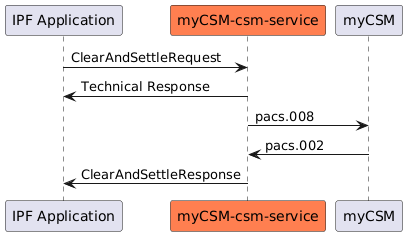
The steps we’ve gone through to implement this workflow can subsequently be used to implement any of the other supported CSM workflows you want to include in your csm service. In summary, this process involves:
-
Implementing the appropriate receive message method(s) in the provided
CsmApiReceiver/CsmRApiReceiverinterfaces -
Creating connectors to forward messages to/receive messages from the CSM, and transforming the messages as required
-
Using the provided senders (e.g.
ClearAndSettleResponseSender) to forward messages from the CSM to IPF
Appendix A: CSM Feature Reference
As described in the Steps section, csm-service-starter-* provides a set of out-of-the-box connectors and associated transports that facilitate the exchange of CSM specific messages between the CSM Service and IPF for all supported CSM workflows. The below table summarises the configuration properties that can be used to enable/disable these connectors, allowing you to tailor your CSM Service feature set to your specific requirements. By default, all the CSM features below are enabled.
| Feature | Property | Description | Default Value |
|---|---|---|---|
Clear And Settle Debtor |
|
Enables the send and ReceiveConnectors associated with the debtor clear and settle workflow. |
|
Clear And Settle Creditor |
|
Enables the send and ReceiveConnectors associated with the creditor clear and settle workflow. |
|
Clear And Settle Technical |
|
Enables the clear and settle technical response SendConnector. |
|
Clear And Settle Notifications |
|
Enables the SendConnectors for clear and settle notifications. |
|
Status Request |
|
Enables the send and ReceiveConnectors for status requests. |
|
Receive Payment |
|
Enables receive payment and receive payment settled SendConnectors. |
|
Recall/Return/Result Of Investigation Debtor |
|
Enables the send and ReceiveConnectors associated with the debtor RRR workflows. |
|
Recall/Return/Result Of Investigation Creditor |
|
Enables the send and ReceiveConnectors associated with the creditor RRR workflows. |
|
Direct Debit Creditor |
|
Enables the Send and ReceiveConnectors associated with the creditor direct debit workflows (direct debit, cancellation, reversal). |
|
Direct Debit Technical |
|
Enables the direct debit technical response SendConnector. |
|
Appendix B: Overriding default CSM Service configuration
Using the transport reference page as a guide, the following examples demonstrate how to override the default locations that the connectors provided in csm-service-starter-* consume from and produce to.
Kafka
csm.kafka {

  producer {
    topics {
      clear-and-settle {
        csm-to-debtor = CLEARANDSETTLE_CSM_TO_DEBTOR //csm-service sends
        csm-to-creditor = CLEARANDSETTLE_CSM_TO_CREDITOR //csm-service sends
        technical-response = CLEARANDSETTLE_TECHNICAL_RESPONSE //csm-service sends
      }
      rrr {
        csm-to-debtor = RRR_CSM_TO_DEBTOR //csm-service sends
        csm-to-creditor = RRR_CSM_TO_CREDITOR //csm-service sends
        technical-response = RRR_TECHNICAL_RESPONSE //csm-service sends
      }
      direct-debit {
        technical-response = DIRECTDEBIT_TECHNICAL_RESPONSE //service sends
        csm-to-creditor = DIRECTDEBIT_CSM_TO_CREDITOR //service sends
      }
      notifications = CSM_NOTIFICATIONS //csm-service sends
    }
  }

  consumer {
    kafka-clients {
      group.id = csm-client-group
    }
    topics {
      clear-and-settle {
        debtor-to-csm = CLEARANDSETTLE_DEBTOR_TO_CSM //csm-service receives
        creditor-to-csm = CLEARANDSETTLE_CREDITOR_TO_CSM //csm-service receives
      }
      rrr {
        debtor-to-csm = RRR_DEBTOR_TO_CSM //csm-service receives
        creditor-to-csm = RRR_CREDITOR_TO_CSM //csm-service receives
      }
      direct-debit {
        creditor-to-csm = DIRECTDEBIT_CREDITOR_TO_CSM //csm-service receives
      }
    }
  }
}
JMS
csm.jms {
  clear-and-settle {
    debtor-to-csm.queue = clearandsettle.debtor.to.csm //csm-service receives
    creditor-to-csm.queue = clearandsettle.creditor.to.csm //csm-service receives
    csm-to-debtor.queue = clearandsettle.csm.to.debtor //csm-service sends
    csm-to-creditor.queue = clearandsettle.csm.to.creditor //csm-service sends
    technical-response.queue = clearandsettle.technical.response //csm-service sends
  }
  rrr {
    debtor-to-csm.queue = rrr.debtor.to.csm //csm-service receives
    creditor-to-csm.queue = rrr.creditor.to.csm //csm-service receives
    csm-to-debtor.queue = rrr.csm.to.debtor //csm-service sends
    csm-to-creditor.queue = rrr.csm.to.creditor //csm-service sends
    technical-response.queue = rrr.technical.response //csm-service sends
  }
  direct-debit {
    technical-response.queue = directdebit.technical.response //csm-service sends
    creditor-to-csm.queue = directdebit.creditor.to.csm //csm-service receives
    csm-to-creditor.queue = directdebit.csm.to.creditor //csm-service sends
  }
  notifications.queue = csm.notifications //csm-service sends
}
Appendix C: Deadletter Appenders
csm-service-starter-* provides two DeadLetterAppender interfaces for handling received messages that fail during processing:
-
com.iconsolutions.instantpayments.csm.ct.CsmCTDeadLetterAppenders: for credit transfer ReceiveConnectors -
com.iconsolutions.instantpayments.csm.rrr.CsmRMessageDeadLetterAppenders: for recall/return/result of investigation ReceiveConnectors