Validation
Validation is a large part of the ISO20022 Message model. There are numerous, increasing levels of "validity" that a message may be attributed to. Different validation level checks are often performed by different software components.
ISO20022 Validation Levels
The below table showcases the exact Message Validity enumeration as specified by the ISO20022 Meta Model, we have also included further qualifying notes and describe which IPF software component would be involved at confirming each Validation Level.
Validation level |
ISO20022 description |
IPF implementation |
Related IPF component |
NO_VALIDATION |
The message instance is not validated. |
Something that is not Syntax Valid cannot be assumed to be parseable, failure is thrown at the deserialisation layer. |
|
SYNTAX_VALID |
The message instance has its syntax validated. |
Something Syntax valid simple means the message has been successfully deserialised into a Java representation. |
|
The message instance is Syntax Valid plus validated against the Syntax Message Scheme. |
This is XSD Schema Validation |
||
The message instance is Schema Valid plus validated against the Message Rules. |
This is the application of the ISO20022 Constraints against Message Components and Datatypes |
||
The message instance is Message Valid plus validated against the Business Rules. |
This is the application of additional Bank Rules / application Rules. |
||
MARKET_PRACTICE_VALID |
The message instance is Message Valid plus validated against the Market Practices. |
This is the application of additional Market Scheme specific rules |
|
BUSINESS_PROCESS_VALID |
The message instance is Message Valid plus validated against the Message Choreography. |
This is whether the message is valid within the context of it’s intended exchange. For example a randomly received orphan pacs.002 may "technically" be market valid, but it is not "valid" in the absence of an originating message) |
|
COMPLETELY_VALID |
The message instance is Message Valid plus validated against all Rules and Market Practices. |
- |
As described above, SYNTAX_VALID check is often performed at the point of deserialisation of an external message, especially with an application that uses a static typed language such as Java to model the Message Abstraction. If we have been able to deserialise the message into our Java model, then it is SYNTAX_VALID, we then look at the next 3 Validation Levels which all relate to the validity of the content within the Message in isolation.
The IPF ISO20022 Message Model provided a validation class MessageComponentValidator which provides the ability to validate a given Message Definition, or Message Component at any, or all of these levels.
Message Component Validator
The Message Component Validator class provides the ability to validate a given Message Definition (or individual Message Component) object. It supports validation for SCHEMA_VALID, MESSAGE_VALID and RULE_VALID. The validations are configurable and reported independently, so that the user has full control over which validations need to be performed at given time.
Schema Rules and Message Rules are implemented as JSR303 Annotations on the Message Component Java classes. The Message Component Validator delegates to a Hibernate Validator implementation for execution of these rules.
|
Validation Levels
Often you may only want to perform SCHEMA_VALID in the receipt of the external message, and postpone the MESSAGE_VALID until a later stage in processing, where the message content may have been enriched. The Message Component Validator is specifically designed to support these scenarios. |
Schema Rules
This is often referred to as "validating a message against a Schema", specifically the XSD associated with the Message Definition. This validation often includes, but is not limited to:
-
Range checks
-
Nullability
-
Pattern restrictions
-
Modality
-
Cardinality
-
Enumeration
-
Exclusivity
Within the IPF ISO20022 Message Model implementation, the validations defined by the XSD schemas are wholly implemented on the Message Model java classed as JSR303 Bean Validation Annotations. There are no XSDs provided for Message Definitions as part of the IPF ISO20022 Message Model. It is not needed to validate the Message Definitions provided by this model against the ISO20022 XSDs, nor is it possible due to the Normalised Types and removal of namespacing.
Validation should be exclusively performed using the Message Component Validator.
|
JSR303 Validator Groups
The Schema Rules are implemented as JSR303 Annotations under the default group. This means any attempt therefore to validate a Message Component directly against a Hibernate Validator (or other implementation) will validate the object against the appropriate Schema Rules. This is similar, though slightly "stricter" scoping than the default set of JSR303 Annotations commonly attached by XJC generated models. The default annotations provided by XJC do NOT honour some Schema Validations such as Choice Components and exclusivity - this was historically left to the XSD validation process, externally to JSR303 Bean Validators |
Including Schema Rules for Validation
To include Schema Rules as part of the validation scope for a validation request, the ValidationOptions parameter needs to be configured to require Schema Rules
We construct a ValidationOptions object that enables Schema Rule validation, this can be done explicitly as demonstrated here or by using one of the common profiles detailed below in Common ValidationOptions.
Defining the ValidationOptions
// Only enable Schema Rule Validation
ValidationOptions onlyValidateSchemaRules = ValidationOptions.builder()
        .applySchemaValidation(true)
        .applyBusinessRuleValidation(true)
        .applyMessageRuleValidation(false)
        .build();
Validating a message object
// This will fail Schema Validation as GroupHeader and PaymentInstruction elements are not present
CustomerCreditTransferInitiationV09 ccti = CustomerCreditTransferInitiationV09.builder().build();

MessageComponentValidator validator = ISO20022MessageModel.getInstance().validator();
ValidationResult<CustomerCreditTransferInitiationV09> result = validator.validate(ccti, onlyValidateSchemaRules);
Verifying the result
The ValidationResult response object contains seperate enumerated levels that indicate the result of Schema Rule, Message Rule and Business Rule, either VALID, INVALID, or NOT_APPLIED, if a rule set was not requested.
The response also contains seperate lists of each Violation type, and an aggregated list of all violations for convenience.
|
So was it valid?
The MessageComponentValidator provides granular responses detailing the input message is valid for different levels. Whilst the result does provide a result.isValid() property, this needs to be carefully considered in the context of the requested ValidationOptions configuration. |
The Violations returned in this example show that Message instance was invalid due to 2 seperate Schema Violations (nullability violation for Group Header and Payment Instruction)
ValidationResult.ValidationLevelResult schemaValid = result.getSchemaValid(); // INVALID

Violation<CustomerCreditTransferInitiationV09> grpHdrViolation = result.getSchemaViolations().get(0);
String name1 = grpHdrViolation.getName(); // {javax.validation.constraints.NotNull.message}
String message1 = grpHdrViolation.getMessage(); // "must not be null"
String properyPath1 = grpHdrViolation.getPropertyPath(); // "grpHdr"
ValidationType type1 = grpHdrViolation.getType(); // SCHEMA_RULE
ConstraintViolation<CustomerCreditTransferInitiationV09> jsrViolation1 = grpHdrViolation.getJsr303ConstraintViolation() ; // Original Validation details

Violation<CustomerCreditTransferInitiationV09> pmtInfViolation = result.getSchemaViolations().get(1);
String name2 = pmtInfViolation.getName(); // {javax.validation.constraints.NotNull.message}
String message2 = pmtInfViolation.getMessage(); // "must not be null"
String properyPath2 = pmtInfViolation.getPropertyPath(); // "pmtInf"
ValidationType type2 = pmtInfViolation.getType(); // SCHEMA_RULE
ConstraintViolation<CustomerCreditTransferInitiationV09> jsrViolation2 = grpHdrViolation.getJsr303ConstraintViolation() ; // Original Validation details
Message Rules
Message Rules are the most interesting part of the ISO20022 Message Model validations. They are formal, logical rules defined against individual Message Definitions or Message Components. However, they are not codified in the traditional XDSs since the rules often cannot be fully articulated in XSD in the same way as a Schema Rule. For example, conditional presence across nested child elements.
These rules are defined within the underlying ISO20022 Meta-Model and E-Repository, where they are referred to as Constraints, they were only exposed through the Message Definition Report supporting documentation, until now.
In the IPF ISO20022 Message Model these rules are implemented as JSR303 "trigger" Annotations, a Message Rule Cache, and dedicated interfaces that need to be implemented for every Message Rule
Overview
The below diagram shows a high level overview of the various classes involved in defining a Message Rule implementation.
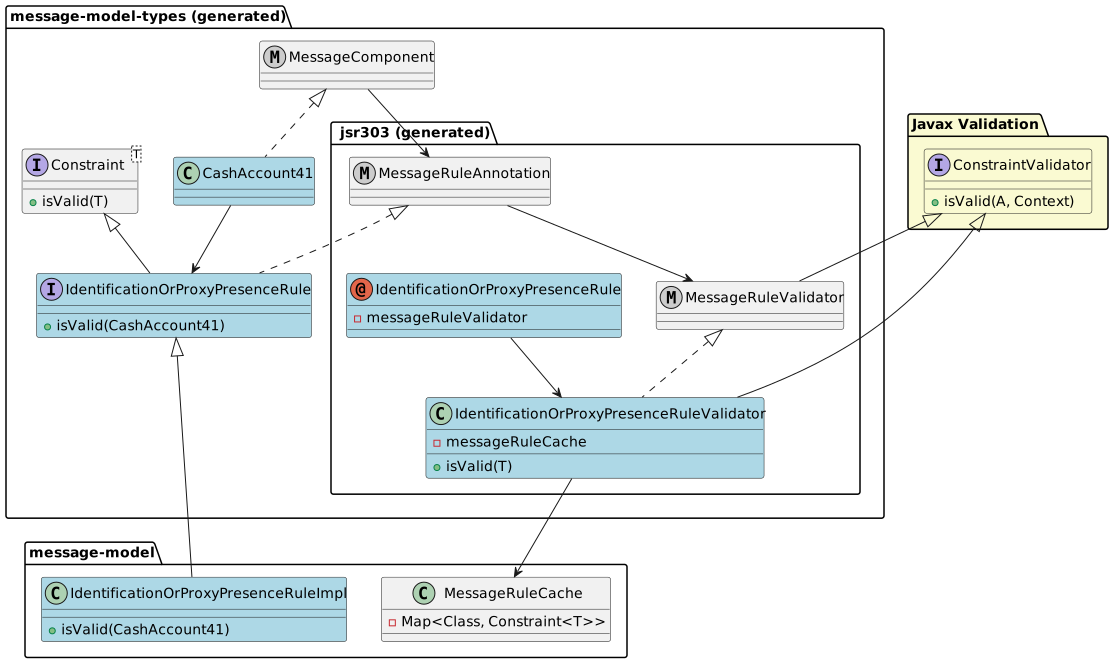
For a given Message Rule, for example "Identification Or Proxy Presence Rule", we generated 3 classes.
-
An Interface specifically for the Rule, which extends an Icon Constraint interface, These rules are then manually implemented by the IPF engineering team for a given Message Definition and provided as part of the Message-Model package.
-
A Jsr303 Annotation that decorates the associated Message Component, in this example CashAccount41.
-
A ConstraintValidator class, that implements the Javax ConstraintValidator contract for the aforementioned JSR303 Annotation
The ConstraintValidator implementation delegates the actual execution of the rule to an implementation of the generated Constraint (1). The ConstraintValidator implementation attempts to resolve a runtime implementation of the rule by searching within a MessageRuleCache instance for a registered implementation. The ConstraintValidator implementation can be instructed by the MessageComponentValidator’s ValidationOptions to either fail or skip if a implementation cannot be resolved from the Message Rule Cache at runtime.
|
The decoupling of the runtime Message Rule implementations from the JSR303 "Triggers" provides the ability for rapid roll-out of new Message Definitions, gradual adoption and implementation of Message Rules, and also the abilty to update and change Message Rule implementation without the need for major release of the Message Model. |
Registering a Message Rule
|
Which Message Rule are implemented?
Implementations of the Message Rules for all the supported Message Definitions will be provided as part of the IPF ISO20022 Message Model, though this may be incrementally released and is not yet complete. |
Whilst the Message Rules are implemented as part of the provided ISO20022 Message Model, we document the process here for completion, and as a reference in case new or alternate Message Rules need to be implemented at the project level.
Firstly we identify a Message Rule to be implemented, in this example we will use a rule that applies to a Cash Account Message Component where at least either the account identification information or proxy information should be provided. These rules can be seen by the presence of the associated JSR303 Annotation on the Message Component itself.
Note how CashAccount41 has an @IdentificationOrProxyPresenceRule to be enforced
...
@IdentificationOrProxyPresenceRule(groups = MessageRule.class)
public class CashAccount41 implements Serializable {
    ...
}
To find the associated Constraint that needs implementing, to be triggered when this Message Component is validatated, simply look in the parent package for an Interface of the same name as the Annotation
com.iconsolutions.iso20022.message.components.cash_account.cash_account41.jsr303.IdentificationOrProxyPresenceRule
vs
com.iconsolutions.iso20022.message.components.cash_account.cash_account41.IdentificationOrProxyPresenceRule
Below is the IdentificationOrProxyPresenceRule Constraint that we need to implement.
Many of the Constraints are documented with a pseudo formal description of the requirement. This can be crucial to highlighting suitable test scenarios for these rules to be validated against.
package com.iconsolutions.iso20022.message.components.cash_account.cash_account41;

/*Generated by MPS */

import com.iconsolutions.iso20022.message.meta.validation.Constraint;

public interface IdentificationOrProxyPresenceRule extends Constraint<CashAccount41> {


  /**
   * Identification must be present or proxy must be present.
   *
   * <pre>
   *
   * <RuleDefinition>
   *     <SimpleRule xmlns:xsi="http://www.w3.org/2001/XMLSchema-instance" xsi:type="SimpleRule">
   *         <mustBe>
   *             <connector>OR</connector>
   *             <BooleanRule xsi:type="Presence">
   *                 <leftOperand>/Identification</leftOperand>
   *             </BooleanRule>
   *             <BooleanRule xsi:type="Presence">
   *                 <leftOperand>/Proxy</leftOperand>
   *             </BooleanRule>
   *         </mustBe>
   *     </SimpleRule>
   * </RuleDefinition>
   *
   * </pre>
   */
  boolean isValid(CashAccount41 cashAccount41);
}
We can then write a concrete implementation of this Rule, for example.
Implementation of a Message Rule
package com.iconsolutions.iso20022.message.components.cash_account.cash_account41;

public class IdentificationOrProxyPresenceRuleImpl implements IdentificationOrProxyPresenceRule {

    @Override
    public boolean isValid(CashAccount41 cashAccount41) {
        return cashAccount41.getId() != null || cashAccount41.getPrxy() != null;
    }
}
These rules will then be independently unit tested as part of the production of the IPF ISO20022 Message Model
Automatic Message Rule Registration
The MessageComponentValidator is configured by default to eagerly populate the MessageRuleCache with implementation of the Constraints. It does this using Reflection (scanning the classpath for the candidate implementors of the Constraint Interfaces) at the point of the ISO20022MessageModel being initialised candidates.
It has logic to detect duplicated candidates, and will also log info messages during startup if not all the rules have been implemented.
As such, so long as the ISO20022MessageModel instance uses the default initialisation, and therefore and uses ScanningRuleCacheInitializer, the implementations should be automatically picked up and applied.
Validating Against Message Rules
We construct a ValidationOptions object that enables Message Rule validation, this can be done explicitly as demonstrated here or by using one of the common profiles
Configuring Validation Options
ValidationOptions onlyMessageRules = ValidationOptions.builder()
              .applyMessageRuleValidation(true)
              .failIfMessageRulesHaveNotBeenImplemented(true)
              .applyBusinessRuleValidation(false)
              .applySchemaValidation(false)
              .build();
Next we validate the CashAccount41 Message Component
Validating a Message
CashAccount41 cashAccount41 = CashAccount41.builder().build();
ValidationResult<CashAccount41> result = validator.validate(cashAccount41, onlyMessageRules);
We then inspet the validation response and confirm that this Message is ot valid sine it violates the aforementioned Message Rule (amoungst several others)
Verifying the Result
List<Violation<CashAccount41>> messageRuleViolations = result.getMessageRuleViolations();
Violation<CashAccount41> violation = messageRuleViolations.get(0);

String name = violation.getName(); // "IdentificationOrProxyPresenceRule"
String message1 = violation.getMessage(); // "IdentificationOrProxyPresenceRule"
String properyPath = violation.getPropertyPath(); // ""
ValidationType type = violation.getType(); // MESSAGE_RULE
ConstraintViolation<CashAccount41> jsrViolation1 = violation.getJsr303ConstraintViolation() ; // Original Validation details
If any Message Rules have not been implemented they will be provided as part of the response through the below method.
Business Rules
Business rules are additional application level rules which may be applied to the ISO20022 Messages for a specific business implementation. These rules are project specific, and could be things such as:
-
Limit check to enforce a total transaction amount cap
-
BIC / IBAN exclusion
-
Restricting of certain currency of Clearing Code for a given payment type.
-
Ensuring that proprietary identifiers adhere t a custom pattern
Implementing a Business Rule
Business Rules, conversely to Schema Rules or Message Rules, are not invoked through JSR303 Annotations, since these rules are defined as part of the implementing project and registered against the target type
To register a Business Rule, first implement the business rule for the exact type. This type should be the exact type would be requested to be validated.
|
Business Rule target classes
Business Rules are evaluated against the exact request type ONLY, they are not cascaded to child classes in the same way as Message Rules or Schema Rules. Until this enhancement is made, it is recommended to use the top level Message Definition class as the target for each Business Rule |
Below we create a new Business Rule, implementing the BusinessRule<T> interface, which requires the implementation of a single method to perform the validation. Multiple Violations may be returned from a single rule, each with their own details. The BusinessRule interfaces contains helper methods such as singleViolation() to construct the Violations.
Defining A Business Rule
BusinessRule<CustomerCreditTransferInitiationV09> msgIdMustStartWithApple = new BusinessRule<>() {
    @Override
    public List<Violation<CustomerCreditTransferInitiationV09>> apply(CustomerCreditTransferInitiationV09 message) {
        if (!message.getGrpHdr().getMsgId().startsWith("Apple"))
            return singleViolation("MsgIdStartsWithApple", "grpHdr.MsgId", "Message ID should start with 'Apple'");
        else {
            return new ArrayList<>();
        }
    }
};
Once a Business Rule has been defined, it needs to be registered with the MessageComponentValidator through it’s BusinessRuleAccess dependency.
Validating against Business Rules
To include Business Rule as part of the validation scope for a validation request, the ValidationOptions parameter needs to be configured to require Business Rules
We construct a ValidationOptions object that enables BusinessRule validation, this can be done explicitly as demonstrated here or by using one of the common profiles described in Common Rule Configurations.
Configuring Validation Options
ValidationOptions onlyValidateBusinessRules = ValidationOptions.builder()
              .applyBusinessRuleValidation(true)
              .applyMessageRuleValidation(false)
              .applySchemaValidation(false)
              .build();
Validating a Message
CustomerCreditTransferInitiationV09 ccti = CustomerCreditTransferInitiationV09.builder()
        .grpHdr(GroupHeader85.builder()
                .msgId("Orange-s2ud2gs423d22").build())
        .build();

ValidationResult<CustomerCreditTransferInitiationV09> result = validator.validate(ccti, onlyValidateBusinessRules);
Verifying the Result
ValidationResult.ValidationLevelResult businessRulesValid = result.getBusinessRulesValid();// INVALID

Violation<CustomerCreditTransferInitiationV09> violation = result.getBusinessRuleViolations().get(0);

String name = violation.getName(); // MsgIdStartsWithApple
String message = violation.getMessage(); // "Message ID should start with 'Apple'"
String properyPath = violation.getPropertyPath(); // "grpHdr.MsgId"
ValidationType type = violation.getType(); // BUSINESS_RULE
Common ValidationOption Configurations
It is often cumbersome to manually define ValidationOptions instance every time. Some preconfigured instances have been provided as static members of the ValidationOptions Class which can be used more conveniently, for example the below invocations peforms only Schema validation, omitting Message Rules and Business Rules.
ValidationResult<CustomerCreditTransferInitiationV09> result = validator.validate(ccti, ValidationOptions.schemaValid());Below is a table describing the provided configurations, their impact and expected usage.
|
Default Behaviour
If no ValidationOptions argument is provided to the validator, is uses ruleValidLoose(). |
This is the highest level of validation that can be performed by the Message Component Validator, but won’t fail if any of the Message Rules have not yet implemented.
| Config | Description | Include Scheme Rules | Include Message Rules | Include Business Rules | Fail If Message Rules are not implemented |
|---|---|---|---|---|---|
schemaValid() |
Only performs Schema validation |
Y |
N |
N |
N |
messageValid() |
Additionally, performs validation against Message Rules |
Y |
Y |
N |
Y |
ruleValid() |
Additionally, performs validation against Business Rules |
Y |
Y |
Y |
Y |
As ruleValid(), but will not fail if not all Message Rules have been implemented. |
Y |
Y |
Y |
N |