Concepts
The IPF Mapping Framework is split into four parts:
-
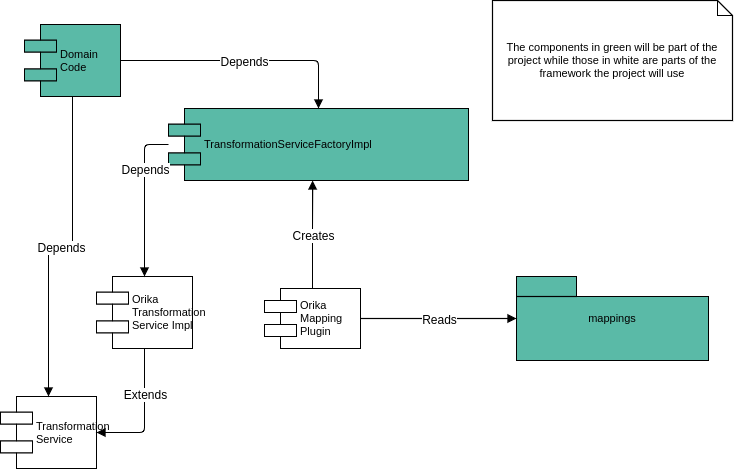
The Transformation API - This is the part that application code will interact with directly, it is mainly interfaces you could be implemented with manually-created mapper. The design approach is that there will be a single transformation service for each bounded context that the application is comprised of.
-
The Orika Transformation API Implementation - While we could support multiple mapping types a series of spikes (see Java Bean to Bean Mapping approach and comparison) we ran selected orika as the best option from the contenders so we have created a single implementation. Your application will depend on this module
-
The framework generates the code that configures the object to object mappings in Orika, this is achieved using a Maven plugin (orika-transformation-generation-plugin)
-
For the case where many of the mappings required can be created implicitly by Orika, we have added a basic reporter that can tell you what automatic mappings will be created between two objects
Here’s a diagram showing how the first three things link together: