Status Request Scheduler (SRS)
The CSM Service offers a Status Request Scheduler (SRS) capability.
Purpose
Some instant payment schemes offer the capability to send a status request message some time after sending a credit transfer (when acting as a debtor) or a payment status report (when acting as a creditor). There are rules relating to when this message can be sent and at what cadence.
The SRS allows the user to automate this capability from within the CSM Service instead of having to schedule these status requests from within an IPF flow, for example.
The actual format of a Status Request message is determined by the individual CSM Service, e.g. converting the Status Request to a scheme-specific pacs.028 message.
The current status request scheduling flows that are supported are:
-
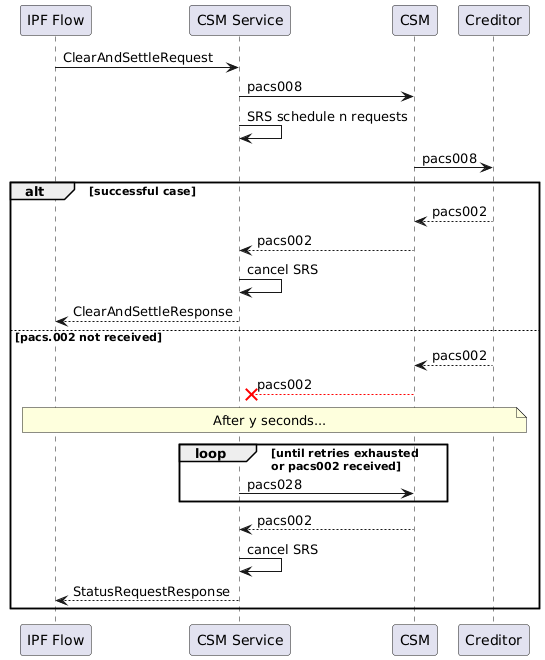
Status Request for ClearAndSettleRequest
-
Status Request for ReceivePaymentResponse
Mechanism
When the CSM Service receives a the relevant message for forwarding onto the scheme, it will set up x scheduled tasks
to send a Status Request message, after y duration, separated by z durations, where:
-
xis the total number of configured Status Request attempts -
yis the initial interval allowed by the payment scheme between the Clear and Settle message and its Status Request -
zrepresents the list of intervals allowed by the scheme between Status Request messages
For the ClearAndSettle flow this would look like the following:
For ReceivePaymentResponse:
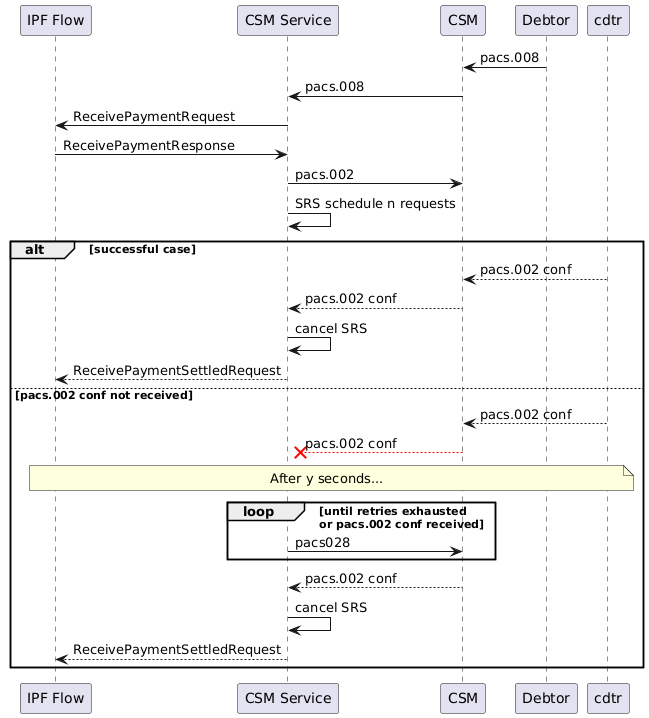
Once a pacs.002 is received (either as a response to the initial message, or as a response to the status request) then the SRS cancels all remaining attempts.
Enabling the SRS
The SRS capability is included with all CSM Service implementations and configurable per flow type (see above), but is disabled by default. It can be enabled by setting a configuration property. See Appendix A below.
Appendix A: Per-flow SRS properties
Each SRS type supports the following configuration:
| Configuration value | Type | Description | Default value |
|---|---|---|---|
|
Boolean |
Is the SRS capability active for ClearAndSettle? |
|
|
Integer |
The total number of status request attempts the SRS will make for ClearAndSettle |
3 |
|
|
Initial delay between sending the Clear And Settle message and sending the first Status Request message for ClearAndSettle |
25 seconds |
|
List of |
List of intervals between Status Request messages for ClearAndSettle.
|
[15 seconds] |
Where [prefix] depends on the Status Request flow:
| Flow type | Prefix |
|---|---|
ClearAndSettle (debtor credit transfer) |
|
ReceivePaymentResponse (creditor credit transfer) |
|